
At some point in every group practice owner's journey, someone asks: what tools are you using?
It's one of my favorite questions to answer — not because I want to sell you on any particular product, but because the tools you choose early shape everything downstream. Your onboarding process. Your reporting. Your ability to hand things off without things breaking. The difference between a practice that runs on systems and one that runs on you personally.
Here's what actually runs ours — and what I'd tell you to set up first if you're just getting started.
Start here. Before anything else.
If you're building a group practice from scratch, three tools go in before everything else:
Simple Practice
The spine of the clinical operation — scheduling, notes, billing, client records.
Google Workspace
Email, shared drives, documents, the company intranet. Your organizational backbone.
Slack
Internal communication that isn't email and isn't text. Where the day-to-day actually happens.
Your EHR
For us, that's Simple Practice. It's the spine of the clinical operation — scheduling, notes, billing, client records. Everything else connects to it or works around it. Don't wait until you have staff to get this right. Get it right first, then bring people into a system that already works.
Google Workspace
Email, shared drives, documents, your company intranet — all of it lives here. When you hire your first person, you create them a company email in minutes and they're immediately inside your ecosystem. It's also where your employee manual lives, your shared templates, your meeting agendas. The organizational backbone that has nothing to do with clinical work but makes everything work.
Slack
Internal communication that isn't email and isn't text. This is where the day-to-day actually happens — quick questions, team updates, async check-ins. The moment you have more than one person in your practice, you need a dedicated channel for internal communication that keeps it out of your inbox. Slack is ours.
Set those three up. Get comfortable in them. Then build outward.

The full stack.
Once the foundation is in place, here's what rounds out our current setup:
Gusto
Gusto handles payroll. It's straightforward, it integrates well, and it takes something genuinely complicated and makes it manageable. For any practice running W2 employees or 1099 contractors, you need real payroll software — not a spreadsheet, not a workaround. Gusto is the one I recommend most often.
Therapy Flow
Therapy Flow is our CRM — and I'll say more about this in a minute because it deserves its own section.
Practice Vital
Practice Vital is our analytics dashboard. It pulls data from Simple Practice and visualizes it in ways that actually inform decisions — caseload by clinician, retention rates, session counts, revenue trends. If you're serious about running a data-informed practice, you need somewhere to see the data clearly. Practice Vital does that for us.
Claude
Claude is our AI layer. I use it constantly — for drafting, for thinking through problems, for synthesizing information, for building out systems and processes faster than I could alone. I'm also watching the space closely for therapist-developed AI tools designed for client-facing support between sessions. That category is still early but it's coming fast, and it's going to change the way we think about continuity of care.
The tool most practice owners sleep on.
The CRM. By a significant margin.
I get it — it's the most intimidating thing on this list. Setting up a CRM well is genuinely complicated. It takes time, it requires you to think carefully about your intake workflow, and it won't do much for you if you rush it.
But once it's working? It is a completely different practice.
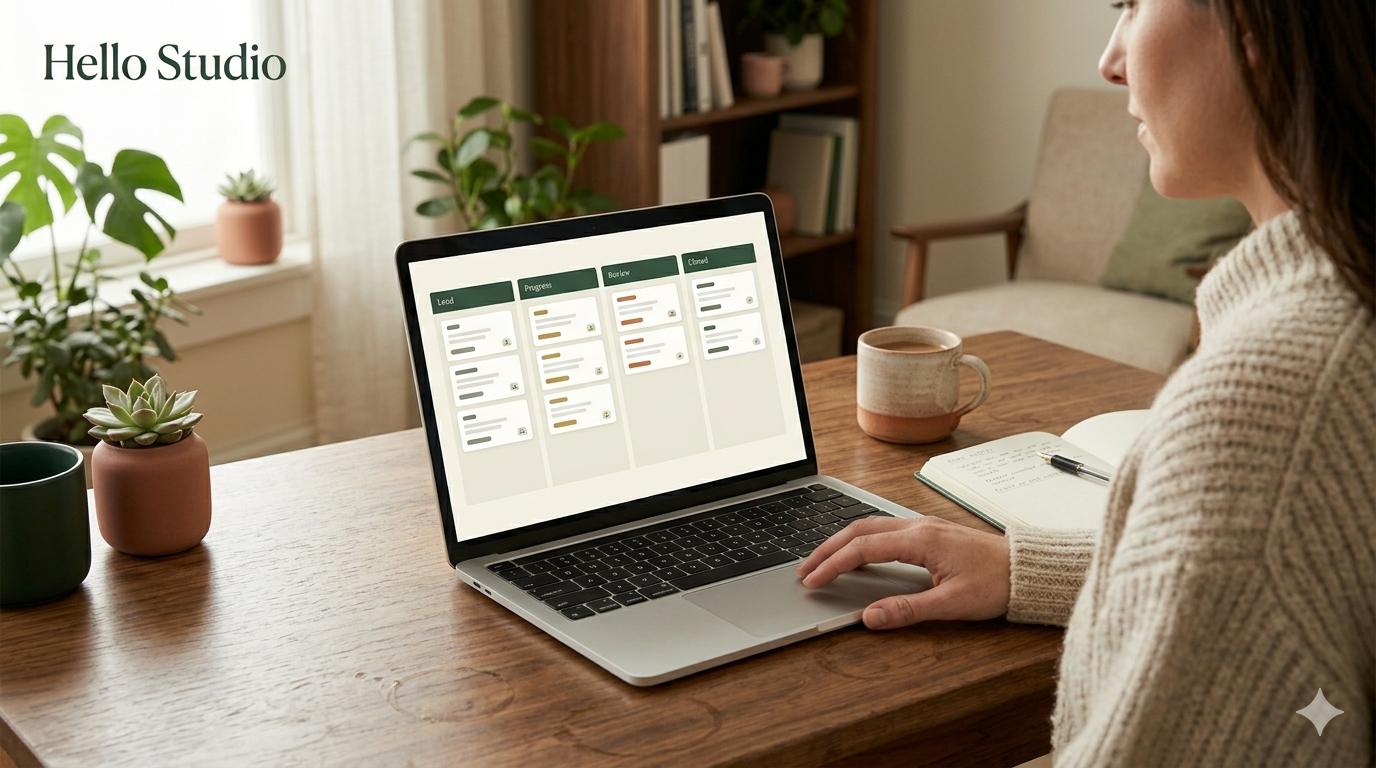
Therapy Flow — the one we use, built specifically for therapy practices — handles lead tracking, automated client touches, intake workflow, email marketing, and reporting in one place. When a new inquiry comes in, the system captures it. When a lead goes quiet, the system follows up. When you want to know where your referrals are coming from this quarter, you pull a report instead of digging through your memory.
Before a CRM, we were doing most of this manually or not at all. After, we had visibility into our pipeline that we simply didn't have before.
The setup investment is real. Do it anyway.
What we ditched.
Mostly marketing tools — social media schedulers, email marketing platforms. Not because any of them were bad, but because once we had Therapy Flow, a lot of that functionality lived in one place instead of scattered across three tabs. Consolidation is its own form of efficiency.
My general rule now: if a tool isn't deeply integrated into how we work, it becomes something to maintain rather than something that helps. I'd rather have six tools I use every day than twelve tools I check occasionally.
How the stack gets stress-tested: onboarding.
One of the clearest signals that your tech stack is working — or isn't — is what happens when you bring on a new clinician.
Our onboarding checklist runs across four areas:
The Four Onboarding Domains
- HR and compliance — contracts, background checks, payroll setup, HIPAA training, NPI.
- Marketing — intro content, directory profiles, headshots, networking introductions.
- Systems orientation — Slack, Google Workspace, building access, email setup, handbook review.
- Simple Practice training — demo mode walkthrough, intake documents, scheduling, note templates.
Each item has an owner. Each owner knows what they're responsible for. Nothing lives in someone's head.
That's only possible because the systems exist first. The checklist documents the systems — it doesn't replace them. If you find yourself onboarding someone and improvising as you go, that's not an onboarding problem. That's a systems problem that onboarding just revealed.

The honest version of how we got here.
We didn't build this stack all at once. We built it through research, word of mouth from other practice owners, and trial and error — in that order. Most of the tools we use now came through recommendations from people who'd already done the work of figuring out what was worth it.
Which is the main reason I write about this stuff. The learning curve for running a group practice is steep, and a lot of the practical knowledge lives in conversations between owners rather than anywhere it's easy to find.
If one piece of this stack saves you six months of figuring it out yourself, that's the point.
Want to think through your own stack?
Studio 1:1s are a good place to start — we can look at where you are and what actually makes sense for your size and stage.
Explore 1:1 Coaching →